Fast Radio Bursts as Probes of Baryonic Processes and Cosmology
Fast radio bursts, first detected in 2007, are millisecond-long, energetic pulses of radio waves of extragalactic origin. In 2020, FRB measurements put the final nail in the coffin for the missing baryon problem (Macquart et al. 2020), the discrepancy between the predicted cosmic baryon budget and the baryon census measured in stars and cold ISM gas. We now know that a significant portion of the baryons reside in the diffuse circumgalactic medium (CGM) and intergalactic medium (IGM). The challenge has now shifted to carefully characterizing this diffuse population of baryons, which is difficult to observe. FRBs, which directly trace the ionized baryon column density through their dispersion measure (DM) without the temperature or velocity dependence of other probes, are the ideal tool to do this. With the upcoming expected detection of 10,000 localized FRBs per year thanks to DSA-2000, CHIME/FRB, and other facilities, we have the important task of preparing our modeling tools, which has been one of the main focuses of my work.
I characterized the contribution of the warm-hot intergalactic medium to FRB dispersion measure and its correlation with the Compton-y parameter (Medlock & Cen 2021).
Using the Cosmology and Astrophysics with Machine Learning Simulations (CAMELS), I undertook the first systematic comparison of FRB statistics, from the scatter in the dispersion measure distribution to the radial profiles of intersecting halos, between different simulation models, establishing FRBs as a future tool to differentiate between different feedback models (Medlock et al. 2024).
In order to use simulations to interpret observations, we must have a thorough understanding of the underlying model. To contextualize my previous work, we quantified the feedback energetics and effects on halo properties in CAMELS (Medlock, Neufeld, et al. 2025). Notably, we found that while the TNG model exhibited higher feedback energetics, the SIMBA model was more effective at moving baryons, due to differences in how the energy is coupled to the halo. We also saw that increasing parameters related to supernovae feedback actually decreased overall feedback energy by suppressing the growth of the central supermassive black hole and delaying the onset of AGN feedback, highlighting the complex interplay between these processes.
I proposed and showed for the first time that FRB statistics, specifically the scatter in FRB dispersion measure, traces the suppression in the matter power spectrum due to baryons (Medlock et al. 2025). This suppression has recently been measured with FRBs for the first time (Reischke et al. 2025; Sharma et al. 2026).
One of the primary systematics in FRB cosmology is the uncertainty in the FRB host halo dispersion measure. I led the simulation comparison in a recent study of FRB host halo CGM dispersion measure with localized FRBs (Leung, Simha, Medlock et al. 2025). We measured for the first time the stellar mass to DM host relation, finding a negative slope, in tension with popular simulation models.
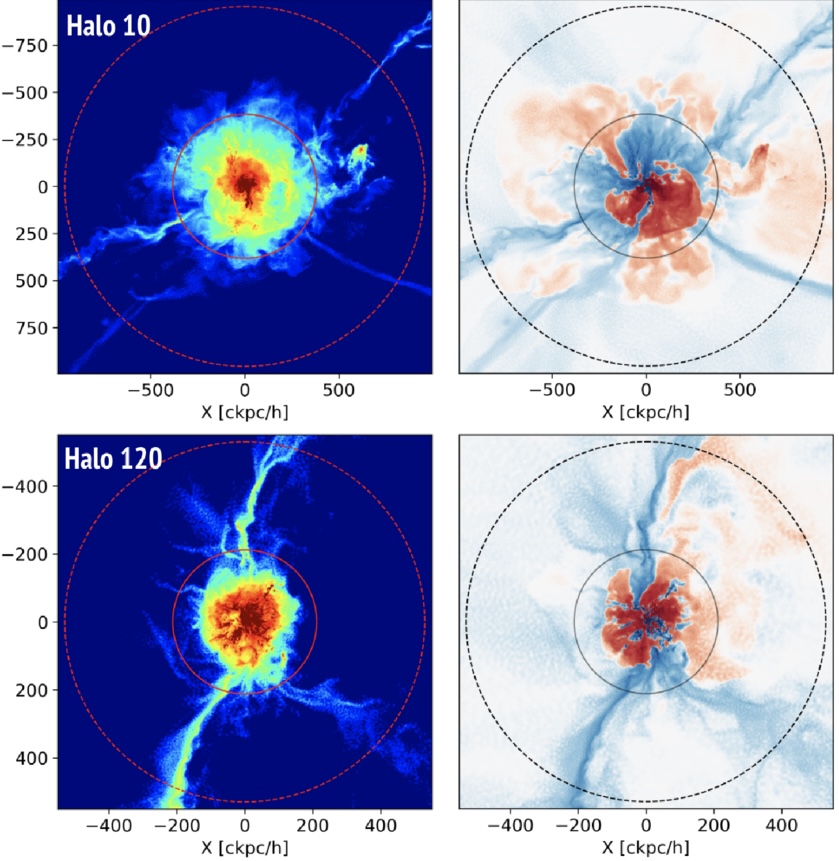
I demonstrated how the cross-correlation between tSZ and FRBs enables us to separate the effects of baryonic feedback and non-thermal pressure, which are highly degenerate in tSZ alone (Medlock & Nagai 2026).